
Green Belt Norms for Industries in India (2026): How Much Land You Must Actually Plant
The blanket 33% green belt rule is gone. What the MoEFCC memorandum of 29 October 2025 actually requires, by pollution category, and what those percentages mean once you have to build the planting and keep it alive.

For years one number governed industrial landscape planning in India: 33 per cent. It sat in environmental clearance conditions, in consent files, in tender scopes, and in the working assumption of nearly every project manager who had ever asked “how much green belt do we need?”
That number no longer stands. On 29 October 2025 the Ministry of Environment, Forest and Climate Change issued Office Memorandum F.No. IA3-22/14/2025-IA.III, superseding its memorandum of 27 October 2020. The blanket figure has been replaced by a graded structure keyed to pollution potential: what you must plant now depends on your category, your air pollution score, whether you sit inside an industrial estate, and whether the site falls in a critically or severely polluted area.
How much green belt is required for industries in India? Since the MoEFCC memorandum of 29 October 2025 there is no single figure. Industrial estates must set aside 10% common green area. Units inside an estate need 15% if red category, 10% if orange. Standalone units need 15% to 25% depending on category and air pollution score, and 40% in critically or severely polluted areas.
For some projects the obligation has fallen sharply. For others it has risen to 40 per cent. This guide sets out what the memorandum actually says — checked line by line against the published document, not against the news summaries — and then the part those summaries leave out: what those percentages mean once you have to build the planting and keep it alive.
What changed on 29 October 2025
The single percentage is gone. The 2020 memorandum specified an overall green area of at least 33 per cent of an industrial estate. Requirements are now tiered by the CPCB pollution categories — Red, Orange, Green, White — and, for air-polluting sectors, by the air pollution index score itself.
Industrial estates carry a distinct duty. A new greenfield estate must set aside common green area as an estate, separately from whatever each unit inside it plants.
Critically and severely polluted areas go the other way. Red and orange units in a CPA or SPA face 40 per cent — higher than the old blanket figure, not lower.
The compliance burden has sharpened. Half-yearly reporting to the pollution control board and to the Ministry’s Integrated Regional Office, including drone imagery for estates, with annual verification.
Coverage at the time framed the revision as a relaxation of green norms. Whether it relaxes anything at all depends entirely on which row of the table you fall into.
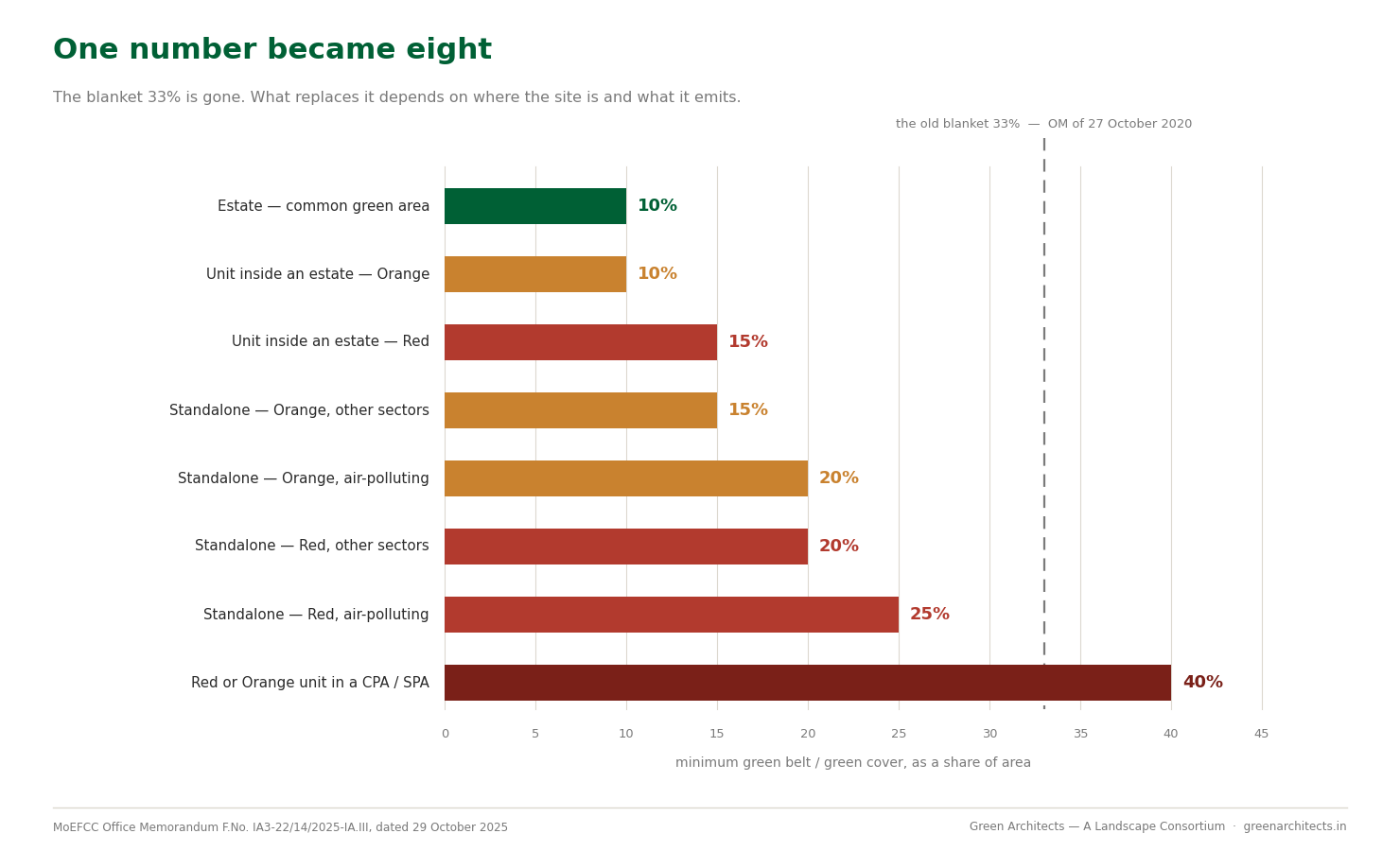
The requirements, by situation
Read these as four separate questions: what a critically polluted location demands, what an estate owes, what a unit inside an estate owes, and what a standalone unit owes.
1. Sites in Critically Polluted Areas and Severely Polluted Areas
A minimum of 40 per cent green belt for red and orange category units located in a Critically Polluted Area or Severely Polluted Area. This follows the Mechanism for Environmental Management of Critically and Severely Polluted Areas, the NGT order of 23 August 2019 in O.A. No. 1038/2018, and the memorandum of 31 October 2019.
Check this first. It overrides the more comfortable numbers below, and it is the row most often missed because it depends on where the site is rather than on what it makes.
2. New greenfield industrial estates and parks
| Obligation | Requirement |
|---|---|
| Common green area | Minimum 10% of the area of the industrial estate |
| Planting density | Dense plantation — 2,500 trees per hectare |
| Who develops it | The owner of the industrial estate |
| Where it sits | At one location, or earmarked across several locations within the premises, clearly demarcated and adding up to 10% of the estate area |
3. Individual member units located inside an estate
| Category | Minimum green belt within the unit’s premises |
|---|---|
| Red | 15% |
| Orange | 10% |
| Green | Optional, with no mandatory requirement |
| White | Optional, with no mandatory requirement |
The estate’s common green area is already carrying part of the load, so the unit’s own obligation is lower than it would be on an isolated site.
4. Individual units outside an industrial estate
The memorandum is precise about the status of this table, and the distinction matters. Individual units outside estates requiring environmental clearance must adhere to the green belt criteria laid down in their EC conditions, based on the recommendations of the sectoral or state Expert Appraisal Committee. The table below is the criteria those committees may refer to. It is the reference; your clearance is the obligation.
| Category | Predominantly air-polluting sectors | Other sectors |
|---|---|---|
| Red | 25% (PIA ≥ 80) | 20% |
| Orange | 20% (PIA ≥ 55) | 15% |
| Green | 10% (PIA ≥ 25) | Optional, no mandatory requirement |
| White | Optional, no mandatory requirement | Optional, no mandatory requirement |
PIA is the air pollution score.
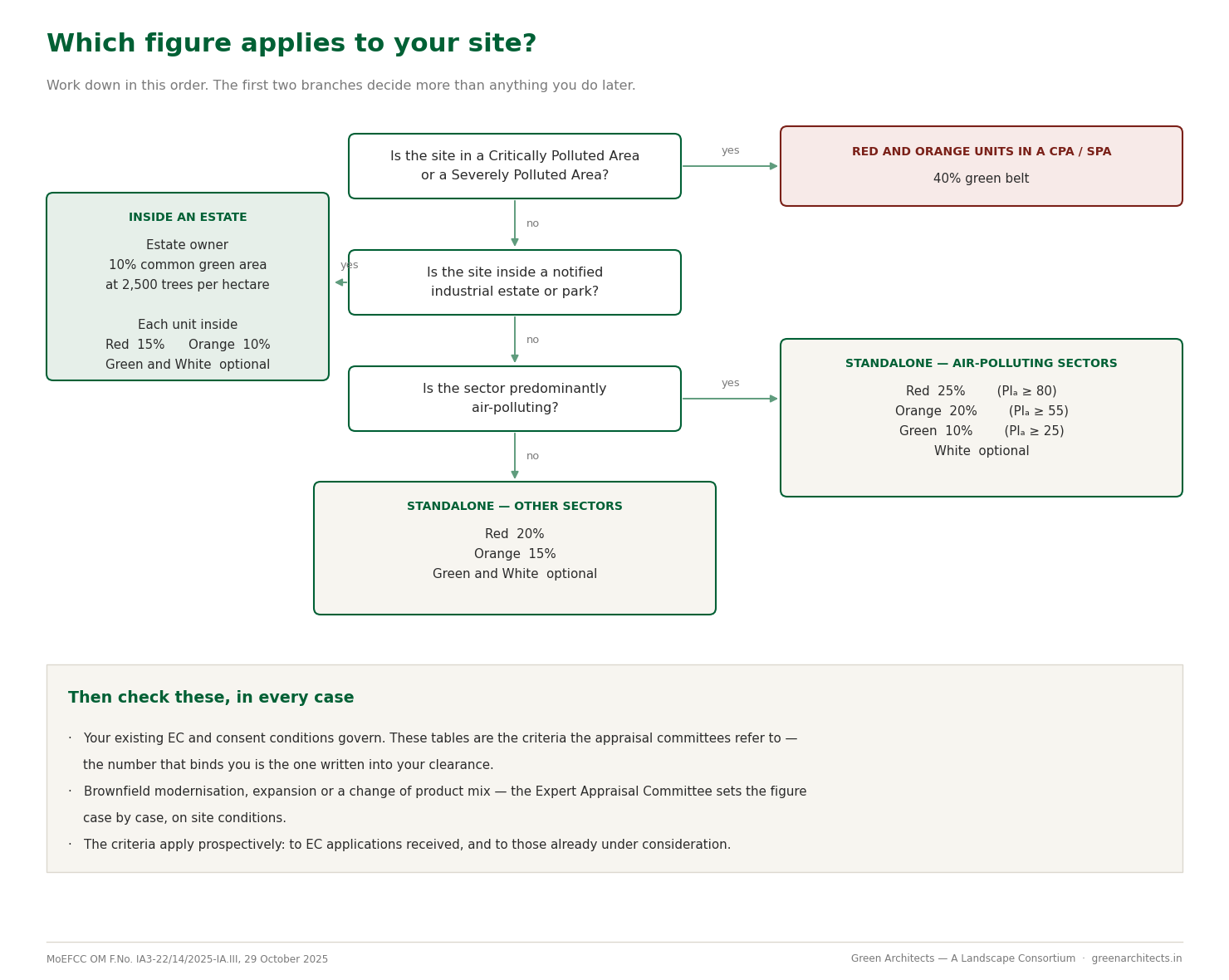
Three provisions that change the answer
Brownfield projects are decided case by case. For modernisation, expansion or a change of product mix, whether inside an estate or standalone, the Expert Appraisal Committees determine the minimum green belt based on on-site conditions and prescribe requirements individually. There is no table to look up.
The criteria apply prospectively. They govern EC applications received after the memorandum and those already under consideration. An existing clearance condition stands until it is revised through the proper route.
Ex-situ plantation is expressly allowed. Over and above the minimum in-situ criteria, units may take up plantation off site, subject to land availability, in collaboration with State Forest Departments, urban local bodies or other government agencies, through schemes such as Nagar Van and compensatory afforestation. For a land-constrained plant this is the most useful sentence in the document, and it is the one least discussed.
Worked examples
| Project | Applies | Land to plant |
|---|---|---|
| Standalone red-category, air-polluting, 40 acres | 25% | 10 acres |
| Orange unit inside an estate, 12 acres | 10% | 1.2 acres |
| Red-category unit in a CPA, 40 acres | 40% | 16 acres |
| New greenfield estate, 300 acres | 10% common green | 30 acres — roughly 30,000 trees |
That last line deserves a pause. Thirty acres of dense plantation is not a landscaping line item. It is a forestry project with a long maintenance liability attached, and it now sits on estate developers who may never have budgeted for it. Planting at that density has more in common with our Miyawaki dense-planting work than with anything most people picture when they hear “landscaping”.
What 2,500 trees per hectare actually means
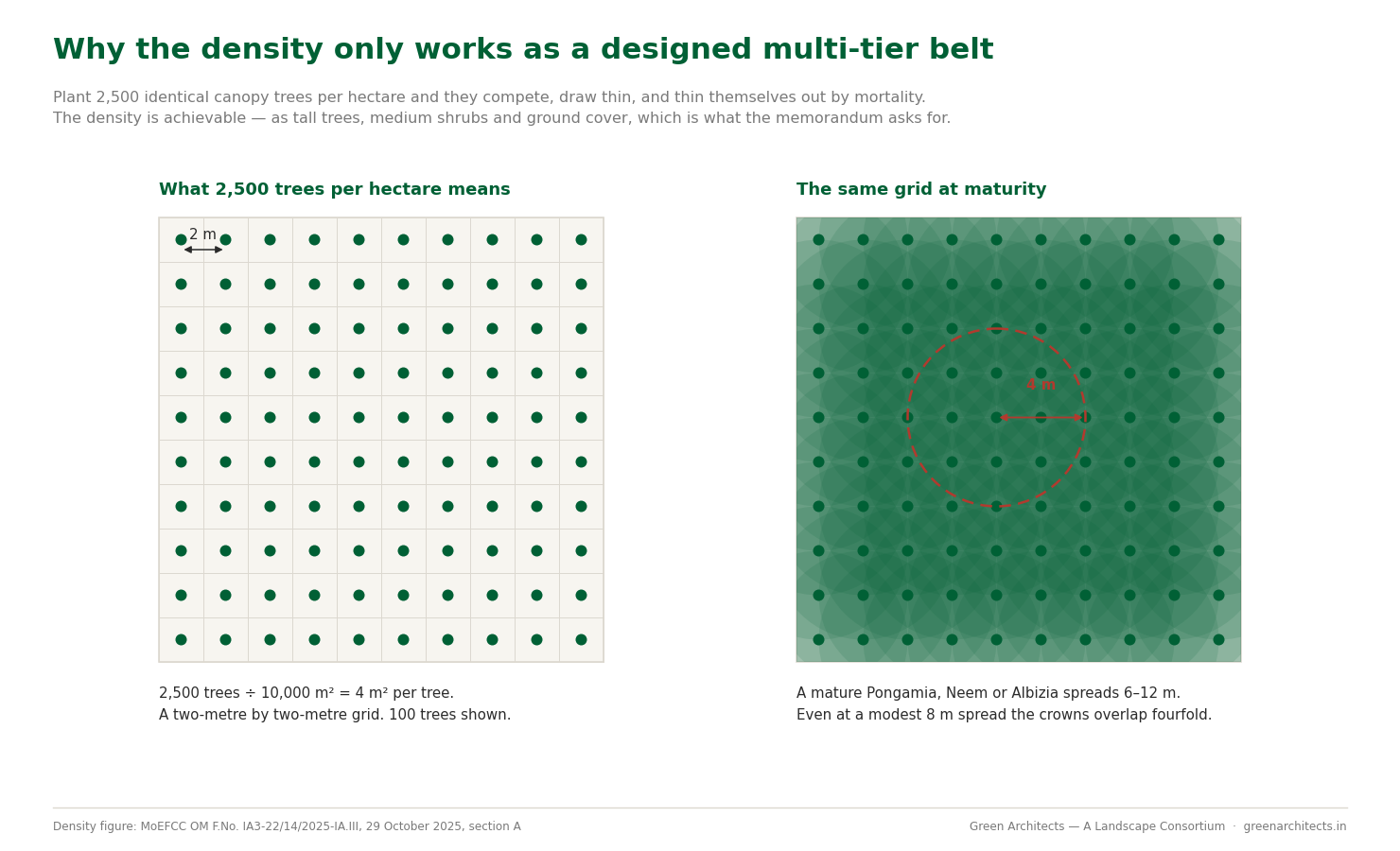
The density is easy to write into a compliance table and easy to underestimate on the ground. Do the arithmetic: 2,500 trees across 10,000 square metres is four square metres per tree — a two-metre by two-metre grid.
That is dense plantation spacing, not avenue spacing. Every mature Indian shade tree worth having in a green belt — Pongamia pinnata, Azadirachta indica, Albizia lebbeck, Terminalia arjuna, Mimusops elengi — reaches a canopy spread of six to twelve metres. Plant 2,500 identical canopy trees per hectare and they are in severe competition by year four, drawn thin and leggy by year seven, and thinning themselves out through mortality after that. Some plantations accept those losses quietly and call them natural. With survival rate now a reported metric, that is a harder position to hold.
What the memorandum asks you to build
Section E of the memorandum is unusually specific for a compliance document, and it settles several arguments that used to be matters of taste.
A multi-tier plantation model — tall trees, medium-height shrubs and ground cover — with adequate width and density commensurate with site-specific pollution levels. Note what this does not say: there is no single mandated belt width. Width follows the pollution load of the particular site, which means it has to be argued from the site rather than copied from a previous project.
Species selected for the job, not for the nursery’s convenience. Native and pollution-tolerant species with proven capacity to absorb dust, gaseous pollutants and noise, and a mix of evergreen and deciduous species so the belt works year round. A belt that goes bare in the dry season is not doing the work in the months it is most needed.
Orientation and placement. The belt should be located as close as possible to the pollution source, aligned perpendicular to the predominant wind direction to maximise interception, and continuous and gap-free along sensitive boundaries. A gap in a belt is not a small defect; wind finds it and the plume goes through.
Soil and water management. Soil enriched with organic matter, proper drainage for sustained plant growth, and secured irrigation support, particularly during the dry seasons.
Maintenance measures. Regular pruning, gap-filling and replanting to maintain density and effectiveness, with pest and disease control for long-term sustainability.
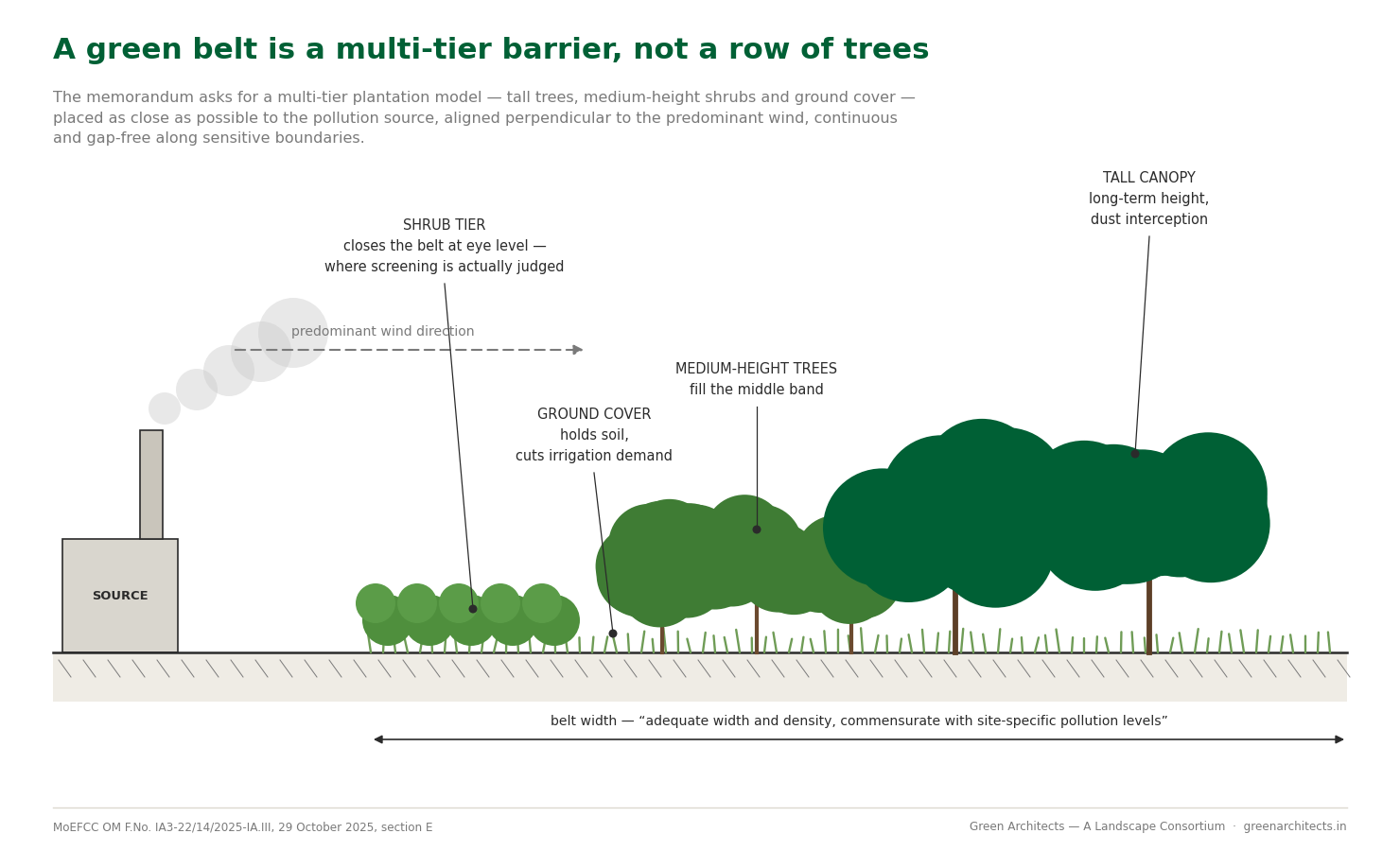
That last point is worth stating plainly, because it is the most common failure in the field. Canopy trees lift their crowns as they mature and open the view straight through at ground level. Screening is judged by someone standing outside the fence at eye height. If the shrub tier is missing, the belt can be fully compliant on tree count and still fail the thing everyone actually looks at. That is the difference between a plantation and a designed screen planting scheme.
The reporting duty is the real change
Percentages have always been negotiable in practice, because nobody was checking. Section F changes that.
For industrial estates: a half-yearly green belt status report to the pollution control board and to the Integrated Regional Office of the MoEFCC, reporting canopy coverage, number of living trees, height and species, and survival rate — including drone imagery. These returns are verified by the regional office and the board annually.
For individual units: half-yearly reports on their green belt area — total area covered, number of trees, species types and other relevant details — as part of their environmental statements to the board. Verified on a random basis at the time of inspections.
And running underneath both: the proponent responsible for plantation must make adequate provision for watering and protection of the saplings for at least five years, and ensure their subsequent sustenance. Five years, in the document, in writing.
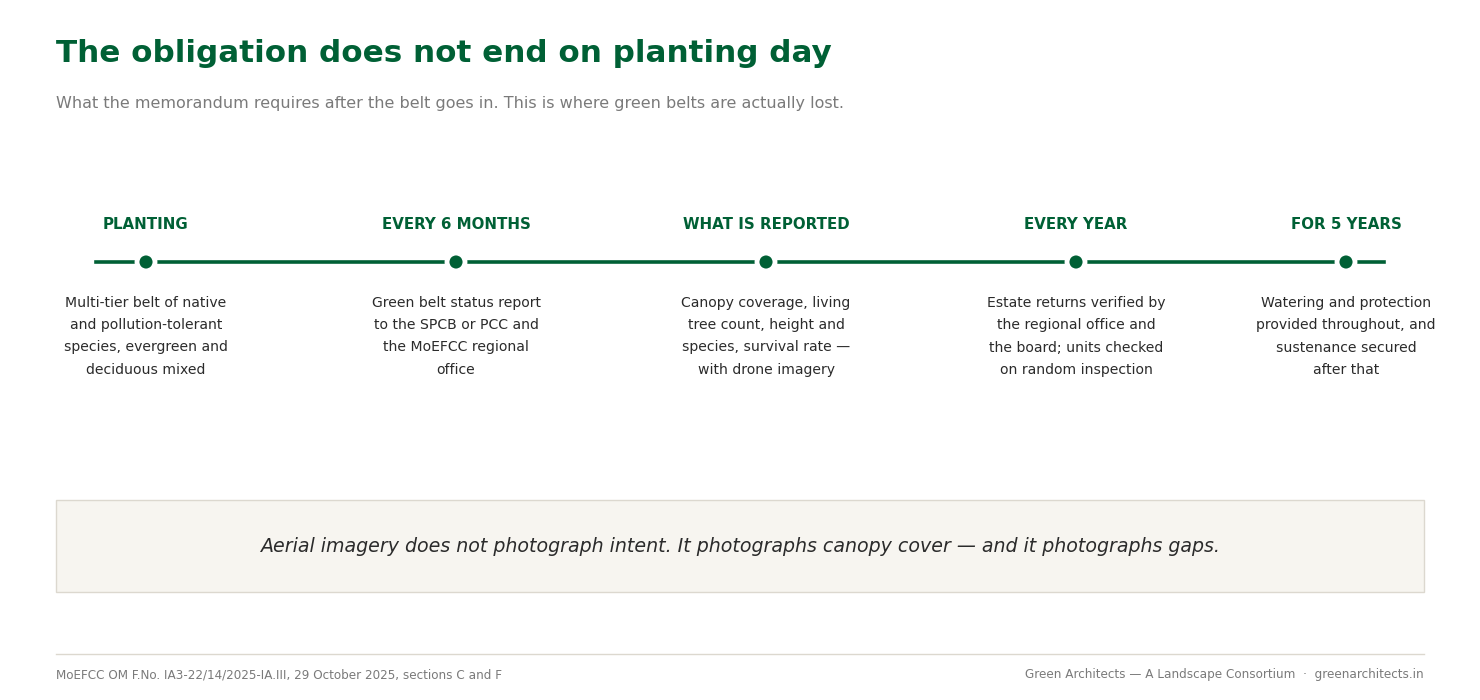
The practical consequence is that the cost of a green belt is dominated by the first five years — watering, weeding, staking, replacement and protection — not by the plants. Plantations fail on maintenance budgets far more often than on design. A belt planted at the right density with the wrong species, the wrong soil preparation or no irrigation plan will read as compliant in year one and be visibly gap-toothed in the drone imagery by year three.
One more line worth knowing: proponents may plant more than the minimum, in situ or ex situ, depending on land and resources. Where a site has the room, exceeding the minimum is the cheapest environmental goodwill available to an industrial project.
Where these belts actually fail
From industrial planting work across sectors, the recurring causes are consistent, and almost all of them are decided before the first pit is dug. Planting into unamended subsoil left over from construction. No irrigation provision for the establishment period, on the assumption that native species need none — they do, until they are established. Grazing and cattle access on an unfenced boundary. Pit sizes too small for the specified tree. Saplings bought oversized and root-bound because they look more impressive at handover. No shrub tier, so the belt never screens. And a species list chosen by nursery availability in the month of planting rather than by the site’s soil, rainfall and pollutant load.
Species discipline deserves its own warning. Delonix regia, Spathodea campanulata, Peltophorum pterocarpum and the ornamental palms and conifers turn up in industrial planting schedules whenever a green belt is handed to a general contractor rather than designed. They are not native, several are brittle and hazardous at maturity, and none of them earn a place in a filtering belt. “Native to India” is also not a specification — native to a semi-arid hard-rock district on alkaline, dust-loaded soil is a specification. A list carried from a coastal site to an inland one is a factual error that shows up three years later as mortality the project pays to replant.
For the sector-specific version of all this — alkaline dust-loaded soils, dust-tolerance ranking by species, mine rehabilitation, dense planting and a twenty-five point failure list drawn from cement plant work — see our detailed guide to green belt development in cement industries.
A checklist before you commit the area
Run these in order, before any layout allocates the green belt to whatever land is left over.
Check whether the site falls in a Critically or Severely Polluted Area. Confirm estate or standalone status. Confirm the CPCB category of the current activity, not the one the site was first approved under. Confirm the air pollution index score, rather than judging “air-polluting” by impression. Read the existing EC and consent conditions for anything stricter. Convert the percentage into an area, then into a genuinely plantable area after drains, fire access, cable routes, pipe racks and setbacks. Check the belt holds real depth along every boundary run, not just the easy one, and leave a maintenance route to the middle rank. Build the species list from the site’s soil, rainfall and pollutant load — native, pollution-tolerant, evergreen and deciduous mixed, in four tiers. Price five years of maintenance alongside the planting. Consider ex-situ plantation where land is genuinely short. Set the monitoring baseline at handover, photographed and geo-tagged.
The percentage is the easy part. Everything that decides whether the belt is still there at the next inspection happens after it.
How we work on industrial green belts
Green Architects — A Landscape Consortium has designed and delivered industrial and institutional landscape since 2001, with more than 70 in-house specialists. We provide landscape design and consultancy across India and internationally, and design, development and maintenance across South India, with the registrations and project record set out in our credentials.
On green belt work that means measuring the obligation against the site rather than assuming it, building a species schedule for the soil and the pollutant load, designing the belt in tiers so it screens at eye level and survives to maturity, and setting up the maintenance and monitoring regime that keeps it compliant at the half-yearly report — not only on planting day. The same discipline runs through our wider corporate, industrial and institutional landscape work.
If you are working out what the revised norms mean for a specific plant or estate, talk to us with the site area, the category and the boundary layout, and we will tell you what is actually plantable.
Questions we are being asked about the new norms
Does the 33% rule still apply to my plant?
Only if it is written into your existing environmental clearance and that condition has not been revised. The memorandum applies prospectively — to clearance applications received after it, and to those under consideration when it was issued. An old EC condition is not automatically rewritten by a new memorandum.
Our site is inside an industrial estate. Do we get the benefit of the estate’s common green area?
Partly. The estate’s 10% is the estate owner’s obligation and sits outside your premises. Your own obligation is separate — 15% within your premises if you are red category, 10% if orange. The estate green area is why those figures are lower than they would be on an isolated site, not a substitute for them.
We genuinely do not have the land. Is there any relief?
Yes, and it is the most useful provision in the document. Over and above the minimum in-situ criteria, plantation may be taken up ex situ, subject to land availability, in collaboration with State Forest Departments, urban local bodies or other government agencies under schemes such as Nagar Van and compensatory afforestation. Read the wording carefully though — it sits alongside the in-situ minimum rather than replacing it.
Is 2,500 trees per hectare realistic, or is it a paper figure?
It is achievable, but not as 2,500 canopy trees. At a two-metre grid a single-tier plantation of shade trees is in competition by year four. The memorandum itself asks for a multi-tier model, and read that way the density makes sense. Read as a tree count alone, it produces a plantation that thins itself out and a survival rate nobody wants to report.
What actually gets checked?
For estates, a half-yearly status report to the pollution control board and the MoEFCC regional office covering canopy coverage, number of living trees, height and species and survival rate, with drone imagery, verified annually. For individual units, half-yearly reports as part of the environmental statement, verified on a random basis at inspection. Canopy cover in aerial imagery is the hardest thing on that list to argue with.
Can we plant more than the minimum?
Expressly yes, in situ or ex situ, depending on land and resources. On a site with room, exceeding the minimum is the cheapest environmental goodwill an industrial project can buy, and it builds margin into the survival-rate reporting.
Source
Ministry of Environment, Forest and Climate Change, Impact Assessment Division, Office Memorandum F.No. IA3-22/14/2025-IA.III (E-275538) dated 29 October 2025, “Rationalizing the requirement of green belt/green cover for Industrial Estates/Parks and individual industries based on pollution potential”, superseding the Office Memorandum dated 27 October 2020. All figures in this article are taken from that document. The Ministry set out its position on the revision in a reply to a parliament question.
This article explains the published norms for general guidance. It is not a compliance opinion. Confirm the requirement applying to your project against your own environmental clearance and pollution control board conditions.