
Commercial Landscape Design in Tamil Nadu: Corporate, Industrial & Institutional Projects

Commercial landscape design balances aesthetics with compliance, durability and low upkeep. Green Architects delivers corporate, industrial and institutional landscapes across Tamil Nadu — design, execution and annual maintenance under one roof.
Key takeaways
- Corporate campuses, factories, hospitals and institutions
- Water-efficient, IGBC-aligned and compliant planting
- End-to-end design, build and AMC across Tamil Nadu
At a Glance: This guide covers professional commercial landscape design for large-scale projects in Tamil Nadu — corporate campuses, manufacturing facilities, hospitals, educational institutions, and hospitality properties. It explains what distinguishes commercial from residential landscape work, what each sector requires, how the design process works, and what procurement managers need to verify before appointing a landscape architect.
Table of Contents
- What Is Commercial Landscape Design — and How It Differs from Residential
- Who Commissions Commercial Landscape Projects in Tamil Nadu
- Corporate Campus Landscaping — Design Principles and Priorities
- Industrial and Manufacturing Facility Landscaping
- Hospital and Healthcare Facility Landscape Design
- Educational Institution Campus Landscapes
- Hotels, Resorts and Hospitality Landscape Design
- The Commercial Landscape Design Process — From Brief to Handover
- Common Mistakes in Commercial Landscape Projects
- How to Evaluate a Commercial Landscape Design Firm in Tamil Nadu
- Frequently Asked Questions
- Work With Green Architects
1. What Is Commercial Landscape Design — and How It Differs from Residential
Commercial landscape design is the professional planning and execution of outdoor environments for non-residential sites — corporate campuses, industrial facilities, hospitals, educational institutions, government buildings, hotels, and public infrastructure. It operates at a fundamentally different scale, complexity, and performance standard than residential landscaping.
The distinction matters because the design parameters are entirely different. A commercial landscape must accommodate hundreds or thousands of daily users without deterioration, meet statutory green cover requirements for planning approval, withstand Tamil Nadu’s climate extremes without constant remedial expenditure, and remain maintainable at scale by a structured professional team under a long-term Annual Maintenance Contract. It must perform reliably for 15 to 20 years — not two or three.
Commercial landscape design is also directly tied to regulatory compliance, institutional credibility, and financial outcomes. For a corporate campus, the external environment affects employee recruitment and retention. For a hospital, it affects patient recovery and infection control compliance. For a hotel, it directly affects occupancy rates and online review scores. These are not decorative outcomes — they are measurable operational results.
Key Insight
A commercial landscape designed by a qualified landscape architect from the concept stage costs less to build, less to maintain, and performs better over 20 years than one assembled by a general contractor after construction is complete. The earlier the landscape professional is appointed, the greater the value they add — and the lower the total lifecycle cost.
The professional landscape architect’s role in commercial projects spans analysis, planning, design, documentation, supervision, and long-term maintenance structuring — a full lifecycle engagement that begins at concept stage and extends through years of operational performance.
2. Who Commissions Commercial Landscape Projects in Tamil Nadu
Tamil Nadu’s sustained growth across multiple development sectors creates consistent and significant demand for professional commercial landscape design. The primary client categories in the state include:
- Corporate campuses and IT parks — particularly in Chennai, Coimbatore and the emerging Trichy corridor — where the landscape forms part of the employee environment and brand identity
- Manufacturing plants, SEZs and industrial estates — where green belt requirements, environmental compliance, and statutory landscaping conditions are the primary drivers
- Multi-specialty hospitals and healthcare campuses — where therapeutic outdoor environments, infection control requirements, and institutional standards define the design brief
- Engineering colleges, universities and school campuses — where campus identity, outdoor learning space, shade provision, and long-term durability determine the design approach
- Five-star hotels, resorts and business hospitality properties — where landscape quality is a revenue-generating asset, directly influencing guest experience, reviews, and rate positioning
- Government and public infrastructure — municipal parks, public institutional buildings, highways and urban landscapes where cost efficiency, durability, and ease of maintenance are the governing parameters
- Residential townships and real estate developments — plotted layouts, gated communities and mixed-use developments where landscape master planning is part of the regulatory approval and sales marketing process
Each of these sectors has different regulatory requirements, different user groups, and different performance benchmarks. A professional commercial landscape architect is trained to work within all of these constraints simultaneously.
“The commercial landscape is not a finishing touch applied after construction. It is a technical system that must be designed from day one — alongside the civil, structural and MEP teams.”
3. Corporate Campus Landscaping — Design Principles and Priorities
The corporate campus landscape serves a dual purpose: it is simultaneously a functional outdoor environment for employees and visitors, and a physical expression of the organisation’s brand and standards. For technology companies, pharmaceutical manufacturers, financial services firms, and large private sector organisations operating in Tamil Nadu, the quality of the campus environment is increasingly a factor in talent attraction, employee wellbeing metrics, and institutional reputation.
- Shade and thermal comfort — Tamil Nadu’s intense summer heat makes canopy tree placement a critical functional requirement. South and west-facing facades need tree cover within three to five years of installation.
- Entry plaza and arrival sequence — the first landscape experience of the campus sets the institutional tone. Fountain features, formal planting geometry, and high-visibility plant specimens are concentrated here.
- Outdoor employee spaces — breakout areas, outdoor seating zones, walking paths and landscape courts that support employee wellbeing and productivity.
- Parking lot landscaping — tree planting within parking areas to reduce the heat island effect of large paved surfaces.
- Green building certification integration — IGBC, GRIHA or LEED credits for heat island reduction, water-efficient irrigation, native species use, and stormwater management.
- Low-maintenance species selection — native and adaptive species with low water and pruning requirements reduce the long-term cost of ownership.
For detailed guidance on corporate campus landscape design: Corporate Campus Landscaping: From Master Planning to Long-Term Maintenance
4. Industrial and Manufacturing Facility Landscaping
Industrial and manufacturing campuses in Tamil Nadu face a distinct and complex landscape brief that extends well beyond visual amenity. The primary landscape requirements include:
- Green belt compliance — Tamil Nadu industrial planning approvals typically require a defined percentage of site area to be maintained as green cover, documented for environmental compliance and factory inspection.
- Noise and dust buffering — dense peripheral plantations of fast-growing trees create functional barriers that reduce dust dispersion and attenuate operational noise.
- Stormwater management — large impervious surfaces generate significant runoff. Landscape design must include grading, swales, retention features, and planted areas that absorb this runoff.
- Miyawaki forest plantations — underutilised peripheral land on industrial campuses is increasingly developed as dense native forest, generating CSR and environmental compliance value.
- Employee facility landscaping — canteen forecourts, security posts, and worker amenity areas with durable landscape treatment that improves the working environment.
Learn more about Landscape Architectural Design services →
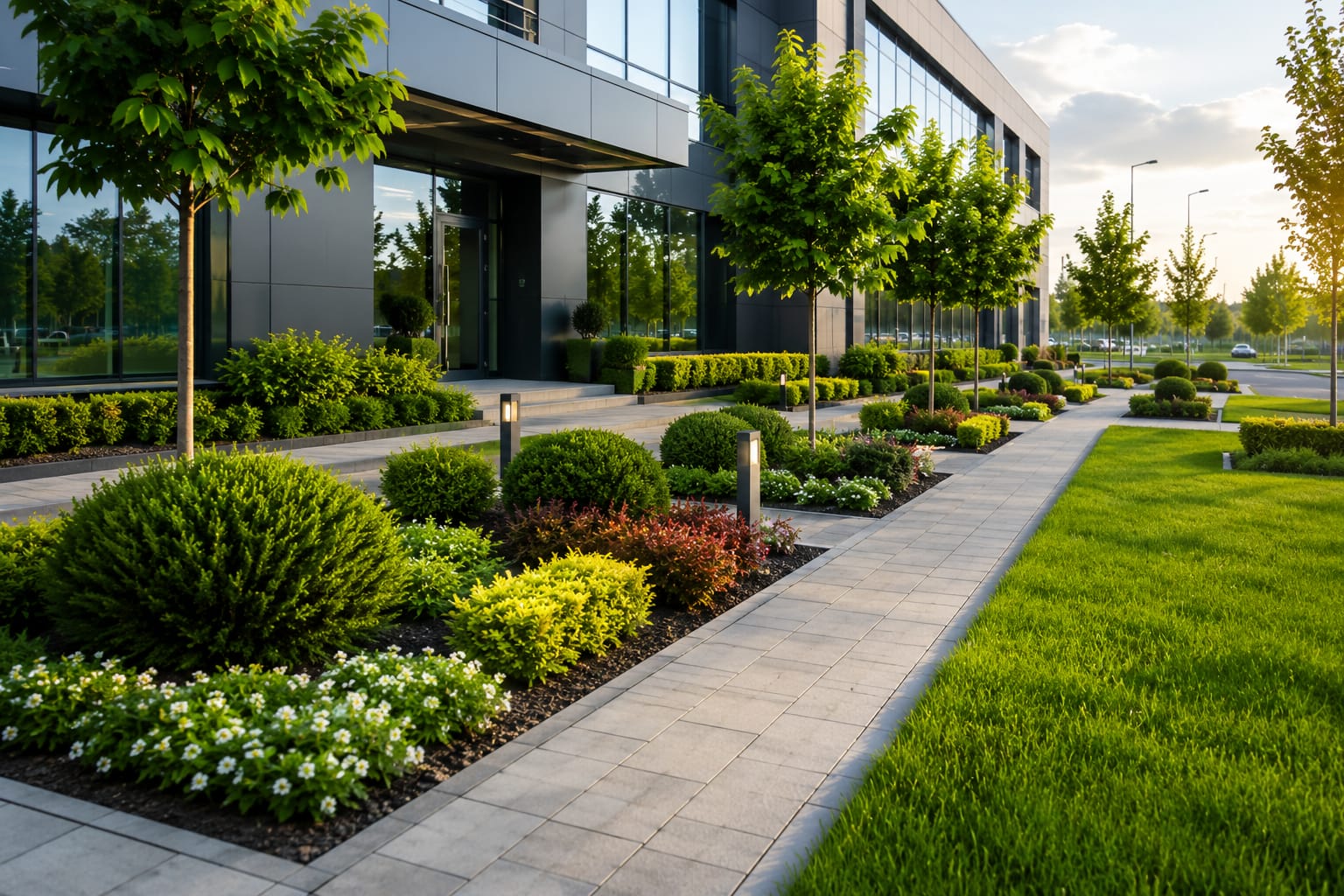
Commercial Landscape Services by Green Architects
5. Hospital and Healthcare Facility Landscape Design
Healthcare facility landscapes in Tamil Nadu operate under design constraints unique to the sector. The outdoor environment must serve patients with limited mobility, support infection control protocols, guide visitors efficiently, and operate with minimal maintenance interruption to clinical activities.
- Therapeutic garden design — access to natural outdoor environments accelerates patient recovery. Designed courtyards, accessible garden walks, and sensory planting areas provide shade, scent, and visual interest without allergen-heavy species.
- Infection control compliance — species selection, drainage design, and mulching specification must all be assessed against infection control requirements to avoid harbouring fungal pathogens or mosquito-breeding conditions.
- Accessibility and wayfinding — pathways must be level, slip-resistant, and wide enough for wheelchair and stretcher movement. Landscape wayfinding supports navigation without additional built infrastructure.
- Emergency access clearance — ambulance bays, emergency vehicle turning circles, and helicopter pad clearance zones impose hard constraints on landscape placement.
- Noise and privacy screening — planted buffer screens between ward windows and carparks, service yards, or busy roads improve patient rest quality.
6. Educational Institution Campus Landscapes
Schools, engineering colleges, arts and science colleges, and universities in Tamil Nadu maintain large campus areas that represent significant long-term institutional assets. The campus landscape directly influences accreditation perceptions, student recruitment, faculty retention, and the day-to-day quality of academic life.
- Shade as a functional requirement — students and faculty moving between buildings in Tamil Nadu’s heat require continuous shade cover along pedestrian routes. Canopy tree selection and placement along campus walkways is a primary functional design priority.
- Outdoor learning spaces — amphitheatres, shaded courtyard seating, botanical garden sections, and demonstration planting areas that support science and horticulture programmes.
- NAAC and accreditation compliance — national accreditation frameworks assess campus infrastructure including green cover, maintained landscape areas, and environmental sustainability initiatives.
- Sports and recreation integration — the landscape plan must coordinate with cricket grounds, football fields, athletics tracks, and outdoor courts, including drainage and irrigation of sports turf.
- Durability under high footfall — student populations generate extremely high footfall. Landscape design must specify durable paving, reinforced lawn edges, and robust plant species.
7. Hotels, Resorts and Hospitality Landscape Design
In the hospitality sector, the landscape is a direct revenue-generating asset. Guest reviews consistently cite outdoor environment quality as a primary satisfaction factor. A well-designed hotel landscape commands higher room rates, generates stronger repeat bookings, and produces better online review scores.
- Arrival and entrance experience — specimen plant selection, water features, landscape lighting, and seasonal colour are concentrated at the porte-cochère and entrance plaza.
- Pool and outdoor leisure zones — pool deck planting must provide privacy screening, visual tropical atmosphere, and shade without creating debris hazards in the pool water.
- Restaurant and dining terrace landscapes — outdoor dining environments require planting that creates intimacy, filters ambient noise, and provides shade. Aromatic species add sensory dimension.
- Lighting design integration — uplighting on specimen trees, pathway bollards, water feature lighting, and facade wash lighting create the premium night-time atmosphere of a five-star property.
- Year-round visual consistency — species must maintain visual quality through Tamil Nadu’s dry season months, not just during the monsoon green season.
8. The Commercial Landscape Design Process — From Brief to Handover
Stage 1 — Site Analysis and Design Brief: The landscape architect conducts a detailed site survey covering topography, soil conditions, drainage, sun orientation, existing vegetation, utility locations, and statutory planning constraints. The client’s brief — functional requirements, green building targets, budget, and maintenance model — is documented and agreed before design begins.
Stage 2 — Concept Design: A landscape concept plan shows the broad zoning of the site — entry zones, planted areas, hardscape, water features, recreation spaces — with indicative species palettes and materials. Approved by client before proceeding. Changes at this stage are inexpensive; changes at construction stage are not.
Stage 3 — Detailed Design and Documentation: Detailed construction drawings: planting plans with species, sizes, spacing and quantities; hardscape drawings with material specifications and levels; irrigation system layout; soil preparation and drainage specifications; Bill of Quantities for tender. IGBC or GRIHA documentation prepared here if required.
Stage 4 — Tendering and Contractor Appointment: Tender documents issued to qualified contractors. The landscape architect evaluates bids and advises on contractor selection based on technical capability, not merely price. A low-price tender from an unqualified contractor consistently produces remedial expenditure that exceeds the initial savings.
Stage 5 — Construction Supervision: The landscape architect verifies that soil preparation, plant specifications, hardscape construction, and irrigation installation match the approved design. Substitutions and shortcuts are identified and corrected during construction, not after completion.
Stage 6 — Completion and AMC Handover: On practical completion, a defects liability period begins. Following defects clearance, the landscape transitions to an Annual Maintenance Contract under a scope and performance standard defined in the AMC agreement.
9. Common Mistakes in Commercial Landscape Projects in Tamil Nadu
These Mistakes Cost More to Fix Than to Avoid
The five mistakes below are the most common — and most expensive — errors observed in commercial landscape projects across Tamil Nadu. Each one is avoidable at the design stage. Each one becomes significantly more costly to rectify after installation is complete.
- Appointing the landscape contractor before the landscape architect — when a contractor is appointed without a design brief, there is no quality benchmark, no specification, and no basis for accountability. The landscape architect must precede the contractor.
- Selecting species based on nursery availability rather than climate suitability — exotic species that look impressive at purchase often fail within two Tamil Nadu summers. Native and climate-adapted species have demonstrably lower mortality and maintenance costs.
- Skipping soil preparation to save cost — Tamil Nadu’s laterite and clay soils require significant amendment before sustaining plant growth. Soil preparation costs represent 10–15% of the landscape budget and determine whether the other 85% succeeds or fails.
- Installing irrigation as an afterthought — systems retrofitted into established planting cause root disturbance and cost more than systems installed during construction. The irrigation contract must be executed alongside landscape construction.
- Signing an AMC defined only by visit frequency — a contract without scope, reporting, or performance standards has no enforcement mechanism. Within 18 months, the landscape deteriorates with no contractual basis for remedy.
10. How to Evaluate a Commercial Landscape Design Firm in Tamil Nadu
- Project scale and sector references — ask for references of completed projects at comparable scale and typology. Request site photographs at two to three years post-completion, not just at handover.
- In-house multidisciplinary team — large commercial projects require landscape architects, horticulturists, irrigation engineers, and civil designers working in coordination.
- Full-lifecycle service capability — a firm responsible for design, construction supervision, irrigation, and long-term AMC under a single contract eliminates divided accountability.
- Documentation capability — the ability to produce formal BOQs, construction drawings, specification documents, and IGBC credit documentation is a marker of professional competence.
- Tamil Nadu climate and regulatory knowledge — ask directly about knowledge of local soil types, species for the specific district’s climate zone, and local authority landscaping requirements.
- Maintenance track record — ask how many completed projects are still under their AMC management. Retained long-term relationships demonstrate satisfied clients and landscapes that performed over time.
11. Frequently Asked Questions
Planning a commercial landscape project in Tamil Nadu?
Talk to Green Architects — Tamil Nadu’s Landscape Consortium
25+ years across corporate, industrial, hospital, educational and hospitality landscape projects. Full lifecycle services from design through AMC. 12 cities. Pan-India reach. Based in Trichy.
Request a Project ConsultationContinue Reading
Green Architects – The Landscape Consortium
Professional commercial landscape architecture services across Tamil Nadu since 2001. Tiruchirappalli | greenarchitects.in | +91 98431 67999